


Pnyx – Birthplace of Democracy
| Message from His All Holiness | the Ecumenical Patriarch Mr. Vartholomeos |
| Elenna Bonner | Chair, Andrei Sakharov Foundation |
| Mstislav Rostropovitch | President, International Sakharov Festival |
| Agni Vlavianos-Arvanitis | President and Founder, Biopolitics International Organisation |
| Carolos Papoulias | Foreign Affairs Minister, Greece Address delivered by Ambassador George Georgiou, Director of Cultural Affairs, Ministry of Foreign Affairs |
| George Papandreou | Minister of National Education, Greece |
| Valery Nikolayenko | Ambassador of the Russian Federation |
| Jiro Kondo | Director General, Research Institute of Innovative Technology for the Earth, Japan |
| Elisabeth Papazoi | Deputy Minister of Environment, Physical Planning and Public Works, Greece |
| Leonid Goldin | GOSCO Cultural Organisation |
| Pavel Sarkisov | Rector, Mendeleyev University of Chemical Technology, Russia |
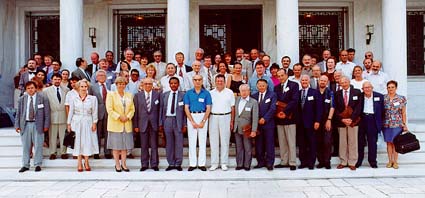
The International Sakharov Festival participants
outside Evgenidion Hall, the site of all conference activities.
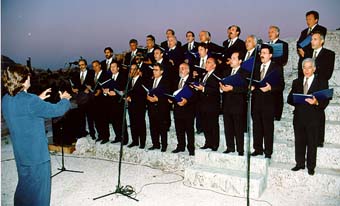
The Chorus of the Commercial Bank of Greece
|
Tebe Poemb |
Lomakin |
|
Two theatre compositions |
Hatzidakis |
| Hunters from Freischutz | von Weber |
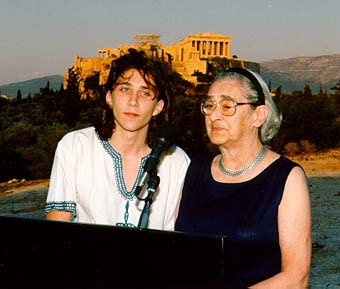
Elena Bonner
There is a great eternal significance in the fact that we have all gathered here today at the birthplace of democracy. Our concern lies in preserving humankind on this planet, as well as preserving culture and the environment.
For many years, propaganda in my country, as well as in many other countries, painted the picture of dissidents as horrible monsters, child eaters, cannibals and people responsible for causing wars. Therefore, being a dissident was very dangerous in my country and many people wondered
whether they should follow such a path. Others did not even wonder, because their feet carried them in that direction.
Mstislav Rostropovich and Yuri Temirkanov never wondered about which direction they should follow; when a group of anti-Semites gathered in St. Petersburg, Yuri Temirkanov did not hesitate to raise his voice against them. At the concert we will all be attending on the occasion of the International Sakharov Festival, we will listen to the music of these two great dissidents.
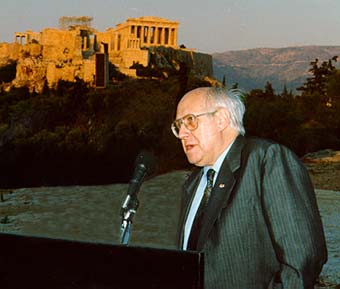
Mstislav Rostropovich
Respectable Elena Bonner and Dr. Agni Vlavianos-Arvanitis, excellencies, ladies and gentlemen. Exactly a year ago, I was introduced to the millennium concept by Dr. Vlavianos-Arvanitis and we spoke about the project that is now being accomplished. I was initially extremely nervous, but now I am extremely happy and extremely excited to be at this Festival.
As a musician, I play music in very different tempos, so I can feel with great sensitivity the tempo of our lives. Each one of us now has a huge responsibility. I remember the great humanitarian words that Andrei Sakharov pronounced in the darkest moments of our lives and believe that we must now take these words and carry them throughout the world with great enthusiasm and dignity.


After observing the activities of the Biopolitics International Organisation, which the honourable Dr. Agni Vlavianos-Arvanitis presides over, and the successes it has achieved over a relatively short period of time, we have had the pleasure of being informed about the International Sakharov Festival and of the participation of distinguished personalities from the worlds of science, politics and the arts. For this festival, you have asked the blessing of the Holy Church, the Ecumenical Patriarchate and of myself.
The growing awareness which can be observed, with respect to the preservation of the natural environment, gives me joy and heartfelt pleasure because, as is well known, the Ecumenical Patriarchate is one of the pioneers in this area and, also because, its relevant goal is to maintain balance and to restore, once again, the connection between Creation, and the Maker and Creator of All Creation, which would guarantee, first, among other things, respect for our environment, a divine gift to all nature. Of course, the obvious destruction of the natural environment, during these recent times, and the clear messages of distress emitted from all of Creation, are the result of the deviation of humanity from its proper course. We can only return to this course by returning to the path of Christ. In this way, the perfect balance, as expressed through the proper relationship between humankind and Creation, all of which comes to humankind from God the Saviour, can be achieved. These divine gifts should be appreciated and used without destructiveness or abuse.
Only in this way can the expansion of humankind’s relation with Creation, through the channel of
our political and cultural life in general, be successfully achieved. The inclusion of these approaches, within an overall framework, should lead toward the third millennium.
With these thoughts, and with feelings of great happiness, the Honourable and Holy Centre of
Orthodoxy congratulates you on your initiative and that of your associates. We send you the wishes
and the blessings of the Church and of our Patriarchs and wish you success with your festival, in the Grace and Mercy of the Creator of the whole of Creation, God, Our Saviour Jesus Christ and all our hopes. With heartfelt prayers.
His All Holiness the Ecumenical Patriarch

 Dr. Agni Vlavianos-Arvanitis.
President and Founder
Biopolitics International Organisation
As the present century is drawing to a close, technological achievements seem almost unreal, as though this rapid progress images intangible concepts. Our future development and survival will depend on our ability to assimilate the explosive progress of technology towards a new bio-culture, webbed with unifying values and based on a better assimilation and appreciation of the gift of bios. Within this framework, culture and technology can co-evolve and enrich each other with positive and complementary dimensions.
Waves of light, waves of music and communication can provide hope and encouragement to help us face the challenges of the new millennium. Personalities such as Andrei Sakharov and enlightened leaders such as Mstislav Rostropovitch have laid the ground for the development of a just and balanced future society. Their contributions, coupled with a global awareness of the need to embrace biocentric values and make the bio-environment the core component in world decision-making, can lead humanity towards a brighter future.
In the search of new models and a new vision for the future, a revival of the ancient Olympic spirit can contribute the necessary dimensions of unity and harmony to the development of human creativity. Presently, the Olympic Games, a beacon for world peace and hope, are limited to physical achievement. However, this restricts the potential of the “Olympic Spirit,” a concept that should evolve to encompass all possible accomplishments, both physical and intellectual. Since 1992, the B.I.O. has been advocating the establishment of Environmental Olympics as an incentive for promoting environmental protection in every field of human endeavour, and the award of interdisciplinary Bios Prizes to those who have contributed to the re-evaluation of priorities in society and the development of new models and thinking for the future. With a grassroots mobilisation and the active participation of every individual in the effort to save bios on our planet, the concept of Environmental Olympics can evolve into a sound institution for world peace and reconciliation in the next millennium.
As we have assembled on the hill of Pnyx, the birthplace of democracy, we should all consider sharing this philosophy and promoting a new vision based on international co-operation, understanding and the harmonious co-existence of all forms of life. By bringing together politicians, diplomats, scientists and artists from all over the world to help save the bio-environment, the International Sakharov Festival can serve as an Environmental Olympics precursor, whereby we can all acknowledge the importance of unity and co-operation, as well as the fact that environmental preservation applies to all aspects of human endeavour. It is an honour to open this important conference on this sacred ground and I hope that these aspirations come across as a message of hope and truth for all humanity.
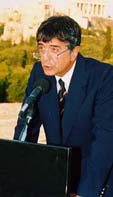 Carolos Papoulias
Foreign Affairs Minister, Greece
Address delivered by Ambassador George Georgiou
With emotion and a great feeling of honour, I welcome, today, at the Pnyx, the centre of democracy, freedom, and, therefore, dignity and honour, the distinguished congress participants. Please accept my assurance that your efforts receive the love and affection of myself, as well as, the Greek government. The work of Biopolitics and of Andrei Sakharov constitute monuments before which today, the whole of humanity must bow since, they constitute essential elements of a pan-humanitarian heritage. This heritage we have been given and we must deliver to future generations with parental care.
Andrei Sakharov fought for the protection of human values. The work of Biopolitics consists of connecting the preservation of the bio-environment and every form of life, to the need to adopt new values in every form of social activity, leading, through education, to an era of bio-culture. This bio-culture constitutes the theme of the International Sakharov Festival. Bio-culture reveals the dimensions which unite all people, irrespective of national, religious and cultural diversity. These dimensions are derived from respect for, and realisation of, the uniqueness of the invaluable gift of life. In this way, the humanitarian bond is verified and humanity finds a new creative role; that of protecting and safeguarding what Biopolitics very rightly names, “the body of bios.” To achieve this goal, Biopolitics calls for the necessity of international co-operation. Through bio-diplomacy, the joint confrontation of issues concerning the bio-environment, friendship among nations will become the major aim of humanity in the future.
Unfortunately, unforeseen engagements created by the, well-known and complex, situation prevailing in the Balkan area do not allow me to be present, to warmly greet the distinguished participants of the International Sakharov Festival. I express, however, warmest wishes for the successful realisation of conference sessions and cultural events, as well as the expectation that the contribution of the International Sakharov Festival will aid the search for new directions which humanity needs to create the culture of the future.
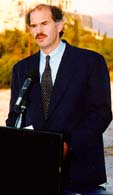 George Papandreou
Minister of National Education
Greece
On behalf of the Ministry of National Education, it is my great pleasure to welcome the distinguished guests of the International Sakharov Festival, organised by the Biopolitics International Organisation. This Festival is dedicated to Andrei Sakharov, a man who devoted his life to serving world peace and human rights. We feel the honour of the presence of, and we cordially welcome, Elena Bonner, the woman who shared Sakharov’s agony and struggle for human dignity. The theme of the Festival deals with the most important issue that concerns the fate of the bio-environment – life on our planet. Since its inception in 1985, the Biopolitics International Organisation has stressed the need to promote new values in order to establish the harmonious co-existence of all forms of life. The concept of bio-culture comprises the unifying dimensions in all fields of human endeavour that contribute to the building of a future based on respect for the bio-environment.
This assembly of decision-makers, from all over the world, as well as world-famous artists, brings to mind the ancient Greek belief in the unity between science, arts and culture. This underlying unity is the quintessence of ancient Greek education, meant to inspire reverence for life and build a harmonious body and spirit. It will be a great success for the Sakharov Festival, the opening of which is held at the Pnyx, the birthplace of democracy, if this meeting draws inspiration from the ancient ideals of education and becomes a source of growth for the values needed in the next millennium. Education can be the catalyst for the creation of the necessary new ethical foundations of society. The role of education is not limited to increasing public sensitisation on environmental issues, it is also of great importance in deepening the understanding of the responsibility of everyone in the joint effort to preserve the bio-environment. Education is expected to motivate future generations to take the essential action needed to protect bio-diversity. At the same time, inspiration can be drawn from many aspects of the bio-environment in order to enrich educational curricula. According to Biopolitics, through this biocentric vision, education can become a pathway to bio-culture. It is widely accepted that environmental issues do not recognise national borders. International co-operation has become an imperative. One important mission of education is to prepare future generations to live together, in a spirit of global interdependence. It is a government’s responsibility to encourage educational reforms in order to lay the ground for the implementation of these ideals. An integrated approach would aim at introducing both theoretical tools and practical guidelines, addressed at all educational levels. In this regard, we would like to express the full support of our government for the International Sakharov Festival and the expectation that this assembly of distinguished personalities will provide essential recommendations and create new perspectives for culture, education and diplomacy, in order to lead to the desired “bio-culture in the next millennium.”
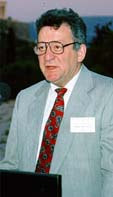 Valery Nikolayenko
Ambassador of the Russian Federation
Let me greet the initiators, organisers and participants of the International Sakharov Festival and, first of all, the esteemed Mrs. Elena Bonner, Mr. Mstislav Rostropovitch, Dr. Agni Vlavianos-Arvanitis and Mr. Kritas who have made such great efforts to turn the idea of this festival into a reality. I would like also to express my gratitude to the Ministry of Foreign Affairs of the Hellenic Republic, under the auspices of which this event is being held, as well as to the sponsors of this festival.
It is deeply symbolic that the Sakharov Festival is being held in Greece – the country where democracy was born. Both in Russia and abroad, the name of Andrei Sakharov has rightfully become a synonym for the tireless struggle to strengthen the principles of democracy. Sakharov’s energetic scientific and public activities won him world-wide recognition and it is not coincidental that a Conference of the Biopolitics International Organisation is being held within the framework of the Sakharov Festival. The objectives of this forum are based on the same principles which Sakharov shared.
For Sakharov, science and politics converged, being held together by his high moral values and social conscience. When speaking of the moral duty of a scientist, he emphasised that, in the modern world, scientists can tremendously influence political power and that is why they bear a special responsibility, in both professional and social areas. The true assessment of the deadly danger for mankind and the environment, originating from nuclear weapons and the uncompromising confrontation between the two world systems, became the starting point of Sakharov’s public activity. As far back as the middle 1950’s, Sakharov started to campaign actively for a ban on nuclear tests in the atmosphere, space and oceans, which became a reality years later.
Through this work, Sakharov asserted the idea of the unity of humankind which transcends social systems and national borders, thus anticipating those notions which are widely acknowledged today. We may be surprised now by many of Sakharov’s predictions in which he tried to prove the necessity for a new world order, based first and foremost on universal respect for human rights. The ideas of Sakharov still remain a guiding light for international efforts, in the field of disarmament and arms reduction and the protection of human rights.
The International Sakharov Festival is a prominent event in the public and cultural life of both Russia and Greece. The arrival in Athens of so many famous representatives of Russian science and culture, as well as journalists, testifies to the keen interest in this festival which is shown in our country, where democratic transformation is becoming a reality. I am confident that the Sakharov Festival will contribute further to strengthening the feelings, of friendship and mutual sympathy, which have linked the Russian and Greek people since ancient times. It will be a good opportunity for deepening fruitful contacts in humanity, science and culture, between Russia, Greece and other countries.
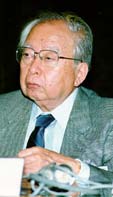 Professor Jiro Kondo
Director General
Research Institute of Innovative Technology for the Earth
Japan
It is my great pleasure and privilege, on behalf of the Central Environmental Council of Japan, to address the opening of the International Sakharov Festival, in this ancient city of Athens. In the works, Historia Plantarum and De Causis Plantarum, written in 300 BC by Theophrastus, he described plants, grasses, flowers, and trees, at a time when the land was covered by forest. In the hunting era, early in the history of humankind, people lived in areas close to forests. In order to secure their food supply, our ancestors began to develop agriculture. It is this, however, which has led to the destruction of the environment. With the development of agriculture, forests were extensively destroyed and, along side the progress of civilisation, the environment was greatly changed. Humans flourished and the world population increased without restraint until people became aware of the catastrophic degradation caused to the environment.
In June 1992, representatives of 108 countries of the world gathered at Rio de Janeiro for the United Nations Conference on Environment and Development and adopted the Rio Declaration. Principle I of the Rio Declaration states: “Human beings are at the centre of concerns for sustainable development. They are entitled to a healthy and productive life in harmony with nature.” I recognise, therefore, that the spirit of the present festival will meet the demands of UNCED. Ancient Greek philosophers also stressed the co-existence of humanity with nature. In Japan, the idea of co-existence will be implemented in the basic plan for environmental policy. In November 1993, the Basic Environmental Law was implemented in Japan. Subsequent to this law, the fundamental plan is being studied at the Central Environmental Council of Japan and includes: recycling of various raw materials, products and wastes; co-existence; participation; and international co-operation, in order to grapple with global environmental problems. These factors make up the basic discipline of the fundamental plan, where the secure co-existence of humanity with nature in a sustainable, sound ecosystem is emphasised. This principle is included in the fundamental environmental plan. Environmental administration should be conducted in the spirit of co-existence.
In conclusion, the spirit of co-existence should be the basis of human behaviour if we are to achieve a sustainable environment in the future. Here in Athens, under the beautiful Acropolis, I would like to be able to study ancient Greek philosophy and recall Greek mythology, in order to discover the path of co-existence. I hope that the International Sakharov Festival will achieve every success.
 Elisabeth A. Papazoi
Deputy Minister of Physical Planning,
Environment and Public Works
Greece
The relationship between human rights and the natural environment is becoming increasingly evident. Governments violating human rights also violate environmental rights, by assuming that natural resource availability is infinite and treating the bio-environment as a source of economic profit. It is not a coincidence that the most outrageous violations of environmental protection principles happen in countries lacking a democratic constitution, or those that are under marshal law.
It is thus an honour for Greece to host the International Sakharov Festival which is dedicated to human rights and the bio-environment. It is also an honour to host the Sakharov Foundation which, inspired by the humanitarian spirit, supports the values of peace, development and human rights. Economic development in our society has been based on the production of ever-increasing quantities of goods, at the expense of dwindling natural resources. If these production and consumption models were to be applied on an unlimited world-wide basis then, the earth’s life-sustaining capacity would easily be exceeded. In the course of the last twenty years, the planet’s population has more than doubled. The world has become a large market-place and, at the same time, twelve million hectares of forests are lost every year, six million of which are becoming desert. By the end of the century, five billion people will be living in poverty-stricken countries. Current economic models are associated with rich countries and only with small minority groups in poor countries. 15% of the world’s population uses 80% of the world’s production. US$ 30 billion are spent yearly on soft drink products at super markets and fast food restaurants in the USA; this amount is almost twice the GNP of Bangladesh. A politician’s promise, a technocrat’s challenge and a dream for the poor: the third world will become the first world, because a world where absolute poverty co-exists with luxury is not politically stable. However, if developing countries adopt the over-consumerist habits of the rich ones, then our planet, which is already in a coma, will die. The world is obviously on the wrong track. Radical changes are desperately needed in economic systems, work ethics and, above all, in society itself. Today’s life-style is neither environmentally conscious, nor socially sustainable. We are condemned to manage a transitional period which is more important than the Agricultural or Industrial Revolution; we are condemned to implement sustainable development.
Sustainable development does not simply entail pollution control and prevention; it is a challenge for people to change their attitudes as producers and consumers. In other words, it is a challenge to change our life-styles. Since sustainable development is related to social change, it relates to the way in which the present generation will satisfy its needs and, at the same time, allow future generations to satisfy theirs. The world has to achieve economic development which does not result in overpopulation, pollution and natural resource over-exploitation. This involves the global community and requires international and intercontinental co-operation. Competition is an important stimulus, but co-operation is critical for success.
The conference on “Biopolitics – The Bio-Environment – Bio-Culture in the Next Millennium,” provides the opportunity to examine all the important problems that concern modern society: environmental degradation, depletion of natural resources and non-sustainable development. Moreover, it can set the ground rules for determining the principles of sustainable development, and establish a biocentric model on which society will be based in the decades to come. Finally, the conference should examine all aspects of the proposed models for sustainable development, in order to ensure their compatibility with the collective national and cultural heritage, to restore the missing link between humans and the natural environment. This should also become a collective effort and responsibility if we are to reverse the currently destructive trends before it is too late. We extend best wishes for this important and timely project.
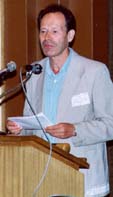 Professor Leonid Goldin
GOSCO Cultural Organisation
Russia
I would like to share a few things with you, with reference to the International Sakharov Festival. About four years ago, a large number of musicians decided to organise something outstanding, dedicated to the memory of Andrei Sakharov. What was the connection between Sakharov and music? Sakharov did not visit concert halls very often. Elena Bonner even criticised me when she said, ” Everybody is trying to make an idol of Sakharov. Now, you even write that he was involved in classical music, that is just not so.”
Regardless, musicians found some link, some connection, between the personality and the activities and ideology of Andrei Sakharov, and the history and essence of classical music. The great composer, Chopin, once said, “Music is a kind of freedom,” and a person as independent as Sakharov can surely be compared to this independence of music. There is also another reason. Shostakovitch claimed that composers and musicians are people who are deeply involved in the problems of the world. Andrei Sakharov was certainly such a person. There is also a lesser reason. The celebrated Russian pianist Ivan Sakharov was Andrei Sakharov’s grandfather.
So four years ago we started the project with the leadership of such prominent musicians as Mstislav Rostropovitch. From the very beginning it was a very successful enterprise. Groups of performers assembled in numerous locations to express support for the Sakharov Festival and to combine the basic idea with various other events. In Moscow, for instance, every year, there is now a special concert dedicated to Sakharov. Many countries including: Israel, Italy, Britain, the United States and Germany, have become supporters and, as such, have already organised events connected with the memory and ideals of Andrei Sakharov.
It was a happy day for me when, a few years ago, I met Dr. Agni Vlavianos-Arvanitis and her friends. I greatly appreciated the unique atmosphere of Greece. It is unnecessary to mention how close the ties are between Russian and Greek culture, and I would only add that we understood each other perfectly from the very start, even in broken English. Within a few days, together with Mstislav Rostropovitch, we had a plan. Now you can see the result, but there is something very special about this event here in Greece, it is a musical festival and conference combined.
Frankly speaking, we were thinking of arranging something like this in Russia, but, with its divided society, instead of a peace conference, we might have ended up with a riot, because there are so many conflicting points of view. There is so little patience or tranquillity in the country that even classical music cannot calm the passions of the people. Many of us, therefore, were wary of the combination of a discussion on social and political issues with a music festival dedicated to Andrei Sakharov. Dr. Agni Vlavianos-Arvanitis, however decided to take the risk and now that we can see how well everything is going we can look forward to a completely successful conference.
In contemporary Russia you cannot even assume, that all members of a delegation share the same ideas, ideals and opinions. Today we have a post totalitarian society in Russia, and only God knows what we will have tomorrow, so this is no time to be blindly optimistic and to say that everything will come out all right in the end. Mstislav Rostropovitch attempted in his own fashion to organise a special concert for those involved in the Karabak conflict. He wished to perform Benjamin Britten’s “War Requiem” and tried to invite American Azerbaijani musicians and singers to take part, but they refused, point blank. There could be no dialogue – their sufferings were too great.
To achieve the best results, something must be done immediately. There is little time and we do not have the moral right to waste that time, and what we achieve here and now will be extremely important. As I have said, we have not the moral right to assume that everything will ultimately turn out all right. The final outcome is a wide open question. For this very reason I have certain propositions to make.
First of all, to support the concert organisation in Russia, established by many renowned musicians and their president Mstislav Rostropovitch; to support the idea of extending the experiences, which we are having here in Greece and many other countries: similar festivals, similar associations between politics and science, seminars and music and to combine the activity between GOSCO and the Biopolitics International Organisation.
We have already discussed the history of The Club of Rome. Why can we not inaugurate a Club of Athens and dedicate it to the resolution of the social and cultural problems of contemporary society? Athens has such a distinguished history that it would seem to be the perfect place to search for new solutions to contemporary problems.
Professor Pavel J. Sarkisov
Rector
Mendeleyev University of Chemical Technology
Russia
In the name of the State Committee of Higher Education of Russia, I am glad to use this occasion to welcome you to the International Sakharov Festival on “Biopolitics – The Bio-Environment – Bio-Culture in the Next Millennium.”
I would like to point out the two significant reasons that make this Festival an important event in the cultural life of the whole world. The first is of vital importance to the present stage of civilisation; the supra-national character of the ideas of Biopolitics, which unites humanity as one of the representations of “Bios,” and calls upon people to live in peace, mutual understanding and harmony with nature. It is this idea that serves as a philosophical and conceptual basis for environmental protection efforts, world-wide.
The second important feature of the world Biopolitical Movement is its dedication to the future. Biopolitical ideas are easily and deeply understood by the younger generation and, in particular, by under, and post-graduate students, of our universities, because they are based on the unique and fruitful combination of eternal truth with state-of-the-art developments of modern biological science and ecology. Russian participants at the Festival deeply appreciate the invitation of the president and founder of the Biopolitics International Organisation, Dr. Agni Vlavianos-Arvanitis and are ready to take an active part in it. We are sure that this Festival will be a new mile-stone in the development of Biopolitical ideas, uniting people of the world on the threshold of the new millennium.
